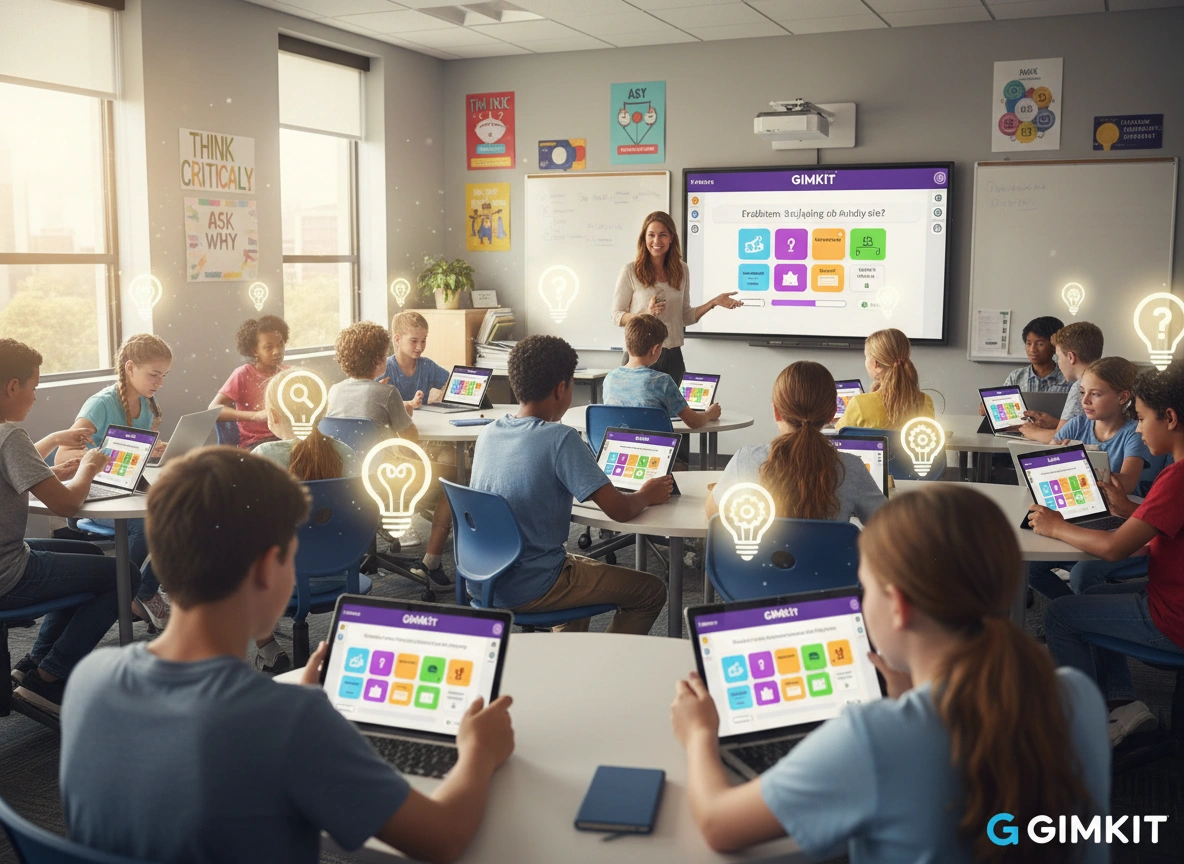
Educational technology has evolved far beyond simple digital flashcards. While rote memorization still has its place, modern classrooms demand tools that push students to analyze, evaluate, and create. Enter Gimkit, a game-show-style platform created by high school students, for high school students, which has rapidly become a staple in K-12 education. Unlike traditional quiz tools that focus solely on recall, Gimkit integrates unique game mechanics—such as strategy, resource management, and collaboration—that transform a simple review session into a complex exercise in critical thinking.
This article explores how Gimkit goes beyond basic gamification to foster deep cognitive engagement, problem-solving skills, and analytical thinking in students.
Beyond the Buzzer: Understanding the Gimkit Dynamic
To understand how Gimkit promotes critical thinking, one must first distinguish it from its competitors. In platforms like Kahoot! or Quizizz, the primary mechanic is usually speed and accuracy: answer the question correctly and quickly to get points. While Gimkit shares the question-and-answer foundation, it adds a layer of economic strategy.
In a standard Gimkit game, correct answers earn students virtual cash. This cash isn’t just a score; it is a resource. Students must decide how to reinvest their earnings to purchase upgrades, power-ups, or insurance. This simple addition shifts the cognitive load. Students are no longer just retrieving information; they are constantly evaluating their performance and making real-time decisions about risk and reward.
This “metagame” layer is where critical thinking begins. A student might ask themselves: Should I spend my money now to earn more per question later? Should I buy insurance because I’m unsure about this topic? Should I sabotage the leader to give my team a better chance? These are high-level executive function tasks that occur simultaneously with content retrieval.
Strategic Decision Making and Resource Management
One of the core pillars of critical thinking is the ability to evaluate options and predict outcomes. Gimkit’s store feature is a masterclass in teaching this skill.
When a student earns their first $50 in the game, they are faced with a choice. They can hoard the money, or they can invest in a “Multiplier” or a “Streak Bonus.”
- The Multiplier increases the amount of money earned per question.
- The Streak Bonus rewards consistent accuracy.
A student who struggles with accuracy might realize that purchasing a streak bonus is a poor strategic investment. Instead, they might opt for “Insurance,” which protects their earnings if they get a question wrong. This requires the student to self-assess their own knowledge level (metacognition) and adapt their strategy accordingly.
Teachers often observe students pausing not because they don’t know the answer, but because they are calculating the most efficient path to victory. They are analyzing the game state, assessing the time remaining, and determining whether a conservative or aggressive strategy is warranted. This is critical thinking in action: applying logic to maximize efficiency in a dynamic environment.
Collaboration and Team-Based Problem Solving
While individual modes in Gimkit foster personal strategy, the team-based modes amplify the need for collaborative critical thinking. Modes like “Trust No One” (inspired by the game Among Us) or “The Floor is Lava” require students to communicate and coordinate.
The “Trust No One” Dynamic
In this mode, students must identify “impostors” within their group while answering questions to keep the ship running. This requires deduction and social analysis. Students must observe the behavior of their peers. Why is that student not answering questions? Why is the ship’s power draining so fast?
This setup encourages students to construct arguments and evaluate evidence. They must accuse peers based on observations and defend themselves with logic. This mirrors the skills needed in persuasive writing and debate: forming a hypothesis, gathering evidence, and drawing a conclusion.
Collaborative Resource Pooling
In other team modes, students pool their money to purchase collective upgrades. This requires negotiation. Students must articulate why a specific upgrade benefits the group more than another. For example, one student might argue for a “Team Multiplier” to boost everyone’s income, while another argues for a “Freeze” power-up to hinder the opposing team. These discussions force students to think beyond their immediate self-interest and consider the broader system—a key component of systems thinking.
Fostering Resilience and Adaptability
Critical thinking is not rigid; it requires adaptability. Gimkit creates an environment where failure is not a dead end but a data point for adjusting strategy.
Because the game allows for infinite respawns and continuous play within a time limit, a student who starts poorly is not eliminated. They can analyze why they are falling behind. Is it a lack of content knowledge? If so, they can slow down and use the “View Correct Answer” feature to learn. Is it a poor economic strategy? They can pivot their spending habits.
This feedback loop builds resilience. In traditional testing, a wrong answer is simply a red mark. In Gimkit, a wrong answer is a temporary setback that can be mitigated by buying insurance or earning a “Second Chance” power-up. This teaches students that errors are manageable problems to be solved, rather than final judgments on their intelligence.
Teacher Strategies for Maximizing Critical Thinking
While the platform provides the tools, the teacher’s implementation determines the depth of thinking. Here are several ways educators can structure Gimkit sessions to prioritize analysis over memorization.
1. The “KitCollab” Feature
Instead of the teacher writing all the questions, “KitCollab” allows students to submit their own questions to the game. Writing a good question is a higher-order thinking skill (Bloom’s Taxonomy: Create).
- Strategy: Challenge students to write questions that cannot be answered by a simple Google search. Ask them to create scenario-based questions or questions that require applying a concept to a new situation. This forces them to deeply understand the material to construct valid distractors (wrong answers).
2. Post-Game Analysis Debriefs
The game shouldn’t end when the timer hits zero. The data provided at the end of a Gimkit session is a goldmine for analytical discussion.
- Strategy: Project the final results and ask the class to analyze the “Game Breakdown.” Ask questions like: “The winner didn’t answer the most questions correctly. How did they win?” or “We struggled collectively with question #7. Let’s break down why that question was tricky.” This turns the game results into a case study on strategy and content misconceptions.
3. Mode Rotation for Different Thinking Skills
Different game modes stimulate different types of thinking.
- Use “Infinity Mode” when the goal is mastery and persistence (focus on accuracy over time).
- Use “Boss Battle” to encourage a unified class strategy against the teacher.
- Use “Draw That” to encourage visual thinking and interpretation, forcing students to translate concepts into imagery.
4. Economy-Only Challenges
Teachers can set constraints that force creative problem solving.
- Strategy: Tell students they cannot answer more than 20 questions, but they must earn $1,000,000. This forces them to ignore speed and focus entirely on maximizing the economic multiplier mechanics. They must calculate exactly which upgrades offer the best return on investment for a low volume of answers.
The Role of Metacognition
Perhaps the most significant contribution Gimkit makes to critical thinking is the development of metacognition—thinking about thinking. Because the game provides immediate feedback on both content knowledge (Did I get it right?) and strategy (Did I lose money?), students are in a constant state of self-regulation.
When a student realizes, “I keep getting questions wrong because I’m rushing to get money,” they are exercising metacognitive control. They are monitoring their own cognitive processes and adjusting their behavior. This awareness is transferable. A student who learns to slow down and verify their work in Gimkit is practicing the same skill needed for solving complex math problems or editing an essay.
Conclusion
It is easy to dismiss classroom games as mere “edutainment”—fun diversions with little pedagogical weight. However, Gimkit distinguishes itself by embedding complex cognitive tasks within its gameplay loop. It moves students from passive consumers of information to active strategists.
By intertwining content review with resource management, negotiation, and systems thinking, Gimkit prepares students for the real world, where knowledge is rarely static and success often depends on how well you can manage assets and adapt to changing circumstances. When used intentionally, it is not just a quiz tool; it is a gymnasium for the mind, training students to analyze, collaborate, and think critically in an increasingly complex world.
Please visit website for more info.