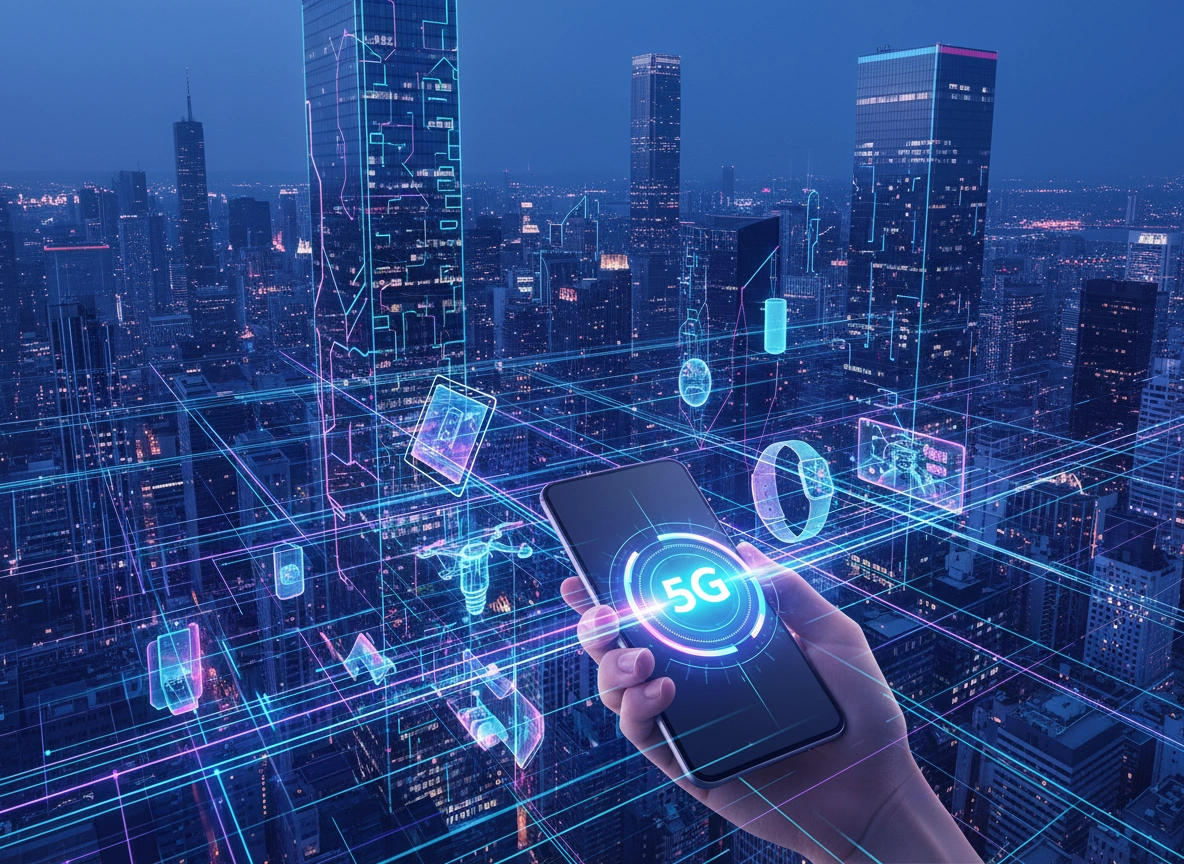
5G is not just a faster version of 4G. It represents a fundamental shift in how devices communicate with each other and the world around them. While previous generations of mobile networks focused primarily on connecting people, 5G focuses on connecting everything.
This fifth generation of wireless technology is unlocking capabilities that were previously theoretical. For smart devices—from the phone in your pocket to the sensors in a factory—5G acts as a hyper-efficient nervous system. It enables instantaneous data transfer and supports a density of connections that legacy networks simply cannot handle.
In this article, we will explore exactly how 5G is reshaping the landscape of smart technology, the specific industries benefiting the most, and the hurdles we still need to clear.
The Technical Leap: Speed, Latency, and Density
To understand the impact, we must first look at the engine under the hood. 5G introduces three primary technical advancements that differentiate it from its predecessors.
Blazing Fast Speeds
The most obvious upgrade is speed. 5G networks can deliver data rates up to 100 times faster than 4G. While 4G tops out at around 1 gigabit per second (Gbps) in perfect conditions, 5G has the potential to reach 20 Gbps. For the average user, this means downloading a 4K movie takes seconds rather than minutes. For smart devices, it means they can transmit massive datasets—like high-resolution video streams or complex telemetry—in real-time without choking the network.
Ultra-Low Latency
Speed is how much data you can move; latency is how fast it starts moving. Latency is the delay between sending a command and receiving a response. On 4G networks, latency typically hovers around 30-50 milliseconds. 5G aims to drop this to as low as 1 millisecond.
This reduction is critical for smart devices that require instant reactions. A smart speaker taking an extra second to play music is annoying. An autonomous car taking an extra second to brake is dangerous. 5G ensures that critical commands are executed almost instantly.
Massive Device Connectivity
Our world is becoming crowded with connected gadgets. 4G networks struggle when too many devices try to connect in a small area—think of the poor signal you get at a crowded concert. 5G solves this with the ability to support up to one million connected devices per square kilometer. This capacity is essential for the Internet of Things (IoT), where smart cities might have thousands of sensors on a single city block monitoring traffic, air quality, and energy usage.
Revolutionizing the Internet of Things (IoT)
The term “Internet of Things” refers to the network of physical objects embedded with sensors and software. Before 5G, IoT was limited by battery life and connection stability. 5G removes these shackles.
Smart Homes and Cities
In the smart home, 5G allows for a seamless ecosystem. Currently, many smart home devices rely on Wi-Fi, which can become congested. 5G allows devices to connect directly to the cellular network, freeing up home bandwidth and increasing reliability.
On a larger scale, smart cities are becoming a reality. Intelligent streetlights can dim when no one is around to save energy. Smart waste bins can signal when they are full, optimizing collection routes. These devices require low power but high reliability, a perfect match for 5G’s capabilities.
Industrial IoT (Industry 4.0)
The impact on manufacturing is profound. Factories are deploying “private 5G networks” to connect robots and sensors. Because 5G is wireless and reliable, factory floors can be reconfigured easily without rerouting miles of Ethernet cables. Machines can communicate with each other to synchronize production lines, and predictive maintenance sensors can alert humans to equipment failures before they happen, saving millions in downtime.
Healthcare: The Rise of Remote Medicine
The healthcare sector is seeing some of the most life-changing applications of 5G technology. The combination of high reliability and low latency is bridging the gap between doctors and patients who may be thousands of miles apart.
Remote Surgery
Telesurgery was once a science fiction concept. With 5G, it is becoming practical. Surgeons can control robotic arms to perform procedures on patients in different locations. The ultra-low latency of 5G is vital here; the surgeon needs tactile feedback (haptics) immediately. If they move their hand, the robot must move instantly. Any lag could lead to surgical errors.
Wearable Health Monitors
Smart watches and fitness trackers are evolving into serious medical devices. With 5G, these wearables can stream real-time health data to medical professionals. Instead of just tracking steps, future devices could continuously monitor heart arrhythmias or blood glucose levels and upload the data to the cloud instantly. AI algorithms can then analyze this data and alert doctors to emergencies before the patient even realizes something is wrong.
Autonomous Vehicles and Transportation
Self-driving cars are perhaps the most anticipated “smart device” of the coming decade. However, an autonomous vehicle cannot rely solely on its internal cameras and sensors. It needs to “talk” to the world.
Vehicle-to-Everything (V2X) Communication
5G enables Vehicle-to-Everything (V2X) communication. This allows a car to communicate with other cars (V2V), traffic lights and infrastructure (V2I), and even pedestrian smartphones (V2P).
For example, if a car three vehicles ahead slams on its brakes, it can broadcast a signal via 5G. Your car receives this signal and begins braking before you—or your car’s cameras—even see the brake lights. Traffic lights can communicate with approaching cars to optimize traffic flow, reducing congestion and emissions. This level of coordination requires the massive bandwidth and low latency that only 5G can provide.
Immersive Entertainment: VR and AR
Virtual Reality (VR) and Augmented Reality (AR) have struggled to break into the mainstream, partly due to hardware limitations. High-quality VR usually requires being tethered to a powerful PC.
5G changes the equation by offloading the processing power. Instead of the headset doing the heavy graphical lifting, the rendering can happen in the cloud. The video is then streamed to the headset via 5G. This allows for lighter, cheaper, and wireless headsets that still offer high-fidelity experiences.
For AR, imagine walking down a street wearing smart glasses. 5G allows those glasses to pull data from the cloud instantly—overlaying restaurant reviews, navigation arrows, or historical facts onto the real world without lag.
Challenges and Limitations
Despite the hype, the rollout of 5G and its integration with smart devices faces significant hurdles.
Infrastructure Cost and Density
5G, particularly the high-speed “mmWave” bands, has a shorter range than 4G. Signals struggle to penetrate walls and obstacles. To make it work, carriers must install significantly more cell towers and small cells—often on every lamppost in a dense city. This infrastructure upgrade is incredibly expensive and time-consuming.
Security and Privacy Concerns
Connecting billions of smart devices increases the “attack surface” for hackers. A 5G-enabled toaster might seem harmless, but if it is part of a botnet, it could be used to attack critical infrastructure. Furthermore, the massive amount of data collected by smart devices raises privacy concerns. With 5G enabling constant surveillance through smart cameras and sensors, regulating how this data is used and stored becomes critical.
Energy Consumption
While 5G is more efficient per bit of data than 4G, the sheer volume of data being processed consumes vast amounts of energy. Both the network infrastructure and the devices themselves face power challenges. Battery technology has not advanced at the same pace as connectivity, meaning 5G smart devices may struggle to last a full day under heavy use.
The Future: Beyond Connectivity
We are only in the early stages of the 5G era. As coverage expands and hardware matures, we will see a shift from “connected” devices to truly “intelligent” devices.
The convergence of 5G and Artificial Intelligence (AI) is the next frontier. 5G provides the pipe to move data, and AI provides the brain to understand it. This synergy will lead to “Edge AI,” where decision-making happens locally on the device or at the nearest cell tower, rather than traveling all the way to a central cloud server. This will make smart devices faster, more private, and more autonomous.
The impact of 5G on smart devices is total. It is the catalyst transforming isolated gadgets into a cohesive, intelligent ecosystem. While challenges regarding infrastructure and security remain, the potential for innovation in healthcare, transportation, and industry suggests that 5G will be the backbone of our digital future.
Please click here for more info